
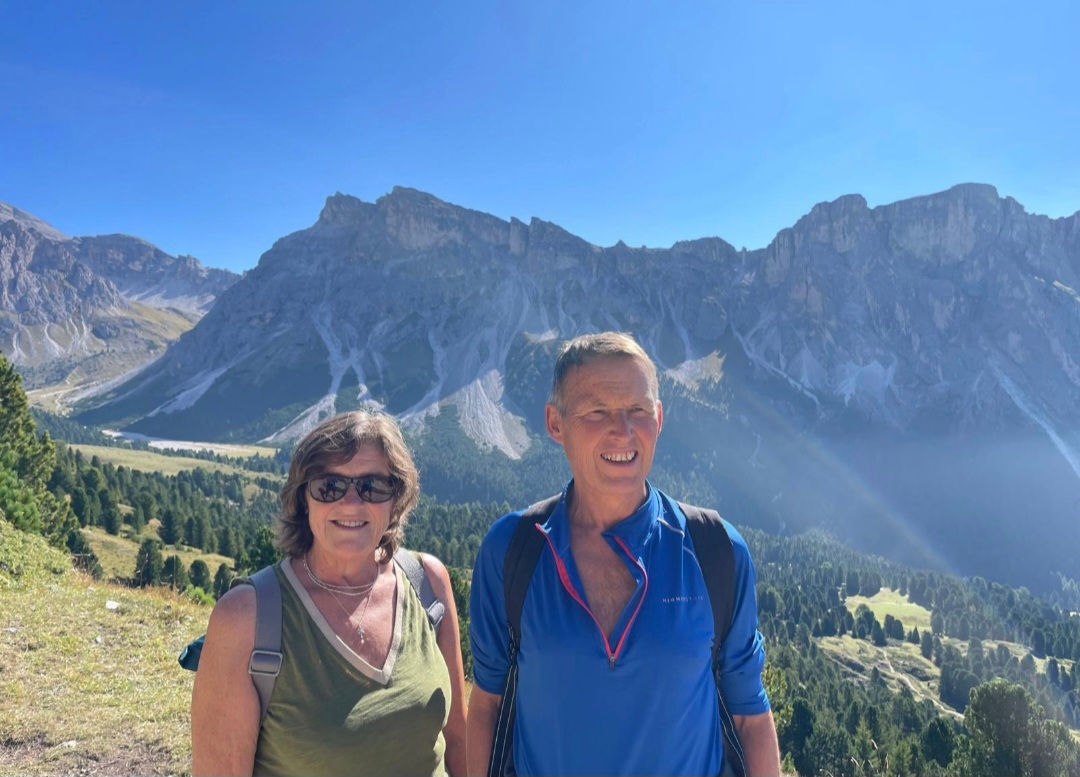
After feeling unwell during an ordinary summer holiday, nothing could have prepared Joyce, a former primary-school languages teacher, for the shock of being diagnosed with inoperable pancreatic cancer.
“We’d been away a couple of times over the summer, and I hadn’t been feeling 100%. I couldn’t eat much and was experiencing pain in my abdomen in the front and back, had a constant niggling discomfort in my left-hand side and was losing weight.
I saw my doctor when we got home who ran some blood tests and sent me for a CT scan at Swansea University near where we live. That’s when they told me they could see a large mass around my pancreas. I was booked in to see a surgeon to discuss my scan results, and he told me straight away it was pancreatic cancer.”
Unfortunately, because the tumour was connected to major blood vessels Joyce had few treatment options.
“The surgeon wasn’t confident he could operate and told me my options were limited. If I could have chemotherapy and tolerate it, I could go on to have radiotherapy. However, if the chemotherapy wasn’t feasible, I was looking at palliative care.”
Joyce began a six-month course of chemotherapy in December 2023 while her husband and 23-year-old daughter started researching radiotherapy options beyond the standard NHS pathway, determined to find her the best care possible.
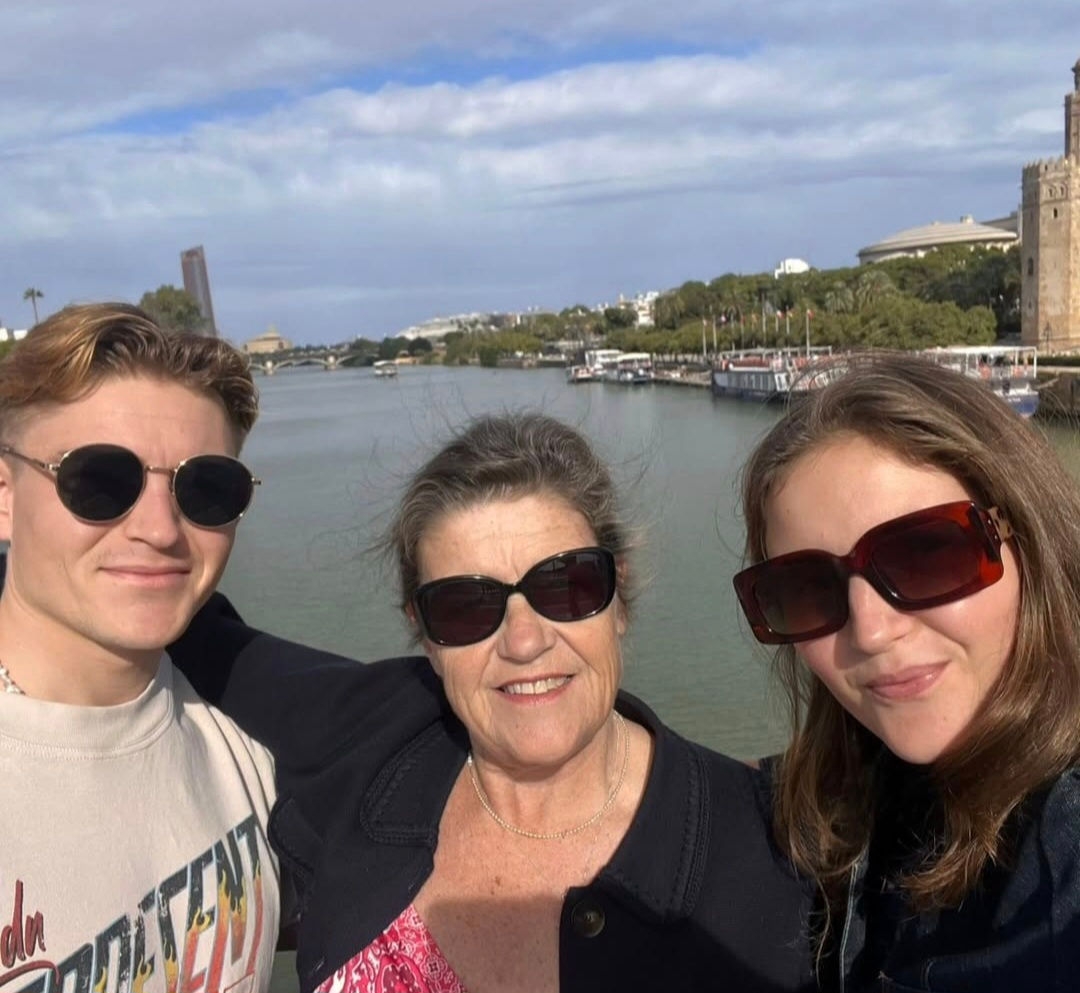
“It was my daughter’s research that helped us find Dr James Good at the GenesisCare specialist cancer care centre in Oxford. She was adamant stereotactic ablative radiotherapy (SABR) using MRI-guidance on a machine called an MR Linac was what I needed based on the research papers she’d found. Because I was so ill, I didn’t have the energy to look into it myself, but my husband checked everything she researched and during my next oncology appointment, my consultant knew Dr Good and put us in contact with him.
We had an initial video consultation with Dr Good who confirmed I was suitable for this type of SABR treatment and that it would be covered by our BUPA health insurance. To be honest, even if it wasn’t, we’d have found a way to pay for it.”
Joyce’s chemotherapy finished in June 2024, and she began her MRI-guided SABR at GenesisCare in Oxford at the beginning of the July.
“The whole process of going to the GenesisCare centre for treatment was sorted by their team for me, I didn’t have to do anything.
My daughter and I booked into an Air B&B in Oxford for the two weeks of my treatment and GenesisCare even contributed towards the cost. We travelled to the centre every other day for my treatment. I had just 5 radiotherapy sessions and when it was finished, I felt great.
The treatment itself was painless and all very straightforward. I was given a breathing technique at my planning appointment to practice which I used whilst I was in the machine. As I held my breath the tumour moved into the treatment position and by lining them up the radiation beam could be delivered. It became a challenge to focus my mind on while I was in the machine, so I wasn’t thinking about anything else that was going on.
Last year, I didn’t feel there was much hope as they weren’t going to be able to operate and thought it was going to be my last year, but here I am! I've travelled to Columbia for 3 weeks and other amazing places I didn’t think I’d be able to visit.
Both the room and the machine are large and because there’s a feeling of so much space, I didn’t feel cramped or claustrophobic.
My appointments were in the morning and while I felt a little fatigued by the evening, I didn’t experience any other side effects. I could leave the centre straight after each treatment session and my daughter and I made the most of the area we were staying in, taking lovely walks, visiting the surrounding villages, including a trip to Blenheim Palace.”
After Joyce’s radiotherapy finished at GenesisCare she went back to see her surgeon who, despite initially being unable to operate, said as the tumour had reduced in size and moved away from the major arteries and an operation was now possible.
Joyce continues, “I had an 8-hour long operation in November 2024 and was delighted when my histology results came back from the biopsy taken during the surgery, which confirmed no cancer was present and nothing had spread anywhere else. It was amazing!”
“I’ve since had three post operative scans and understand I’ll have an MRI scan in 5 years unless I show any symptoms in the meantime. I did ask Dr Good when I was going through my radiotherapy treatment that if anything reappeared in the future if it would be possible to have this treatment again and he said I could, one more time. I wouldn’t hesitate to if I needed to, but touch wood I won’t.”
Of her treatment journey, Joyce explains: “Having my chemotherapy and surgery with the NHS and my radiotherapy privately, I was a little concerned how all my information would link up, but everything was seamless and the relevant information sent back to my consultant, so it wasn’t an issue.”
Joyce concludes: “It feels like it hasn’t happened to me. I feel totally normal and life has gone back to usual. Psychologically I’m still someone that’s gone through cancer but I’m forever grateful!
Last year, I didn’t feel there was much hope as they weren’t going to be able to operate and thought it was going to be my last year, but here I am! I travelled to Columbia for 3 weeks and other amazing places I didn’t think I’d be able to visit.”

Dr James Good explains, "It is wonderful to see Joyce thriving after everything she has been through. Inoperable pancreatic cancer is such a difficult disease for people affected, because chemotherapy alone rarely makes the tumour operable and standard radiotherapy techniques have limited effectiveness. By using the higher doses made possible by MRI-guidance, and working closely with her local team, we were able to obtain the best possible outcome."
The MR Linac technology is available at our centres in Surrey, Oxford and Cromwell Hospital in London. Your cancer specialist can refer you for a consultation. We’re recognised by all major insurers and we’ll help you with transport depending on treatment and locations, when required.
Make an enquiry
If you'd like more information about MRI-guided stereotactic ablative radiotherapy for pancreatic cancer, contact us today